Reflection
- Home
- Reflection
Deep reflection is the intense, conscious process of looking inward to analyze experiences, beliefs, or emotions, often leading to personal growth, change, or profound understanding. It involves moving beyond surface-level thinking to examine the “why” behind events and feelings, acting as a mental “breakout” from daily routine.
Before the Cross: Sacred Art in Europe and Africa’s Ancient Worlds

Illustration: the-gundestrup cauldron
Illustration text: The Gundestrp cauldron is richly decorated with mythological scenes and deities
Before the spread of Christianity across Europe and parts of Africa, art functioned less as an object of passive admiration and more as an active force—embedded in ritual, governance, cosmology, and daily life.
Illustration Battersea Shield
Illustration text: Ornamental bronze work with La Tène-style abstraction
Ancient Europe: Myth & Abstraction
In ancient Europe, pre-Christian visual culture was shaped by myth, seasonal cycles, and tribal identity. The intricate metalwork of the La Tène period, for example, reveals a mastery of abstraction—spirals, knotwork, and stylized animal forms that seem to move even in stillness.
These designs were not merely decorative; they encoded belief systems tied to nature, transformation, and the unseen world. Similarly, megalithic structures such as Stonehenge speak to a sophisticated understanding of astronomy and ritual alignment, where architecture itself became a conduit between earth and cosmos.
Monumental Ritual Landscape
The La Tène culture was a European Iron Age culture. It developed and flourished during the late Iron Age (from about 450 BC to the Roman conquest in the 1st century BC), succeeding the early Iron Age Hallstatt culture without any definite cultural break, under considerable Mediterranean influence from the Greeks in pre-Roman Gaul, the Etruscans,[1] and the Golasecca culture,[2] but whose artistic style nevertheless did not depend on those Mediterranean influences.
Etruria & The Visible Divine
Across the Mediterranean, long before Christianity took hold, the art of ancient Greece and Etruria centered on gods who embodied human complexity. Etruria was an ancient region in central Italy, roughly covering modern Tuscany, northern Lazio, and western Umbria, home to the sophisticated Etruscan civilization between the 9th and 3rd centuries BC. Renowned for their art, trade, and 12-city confederation, the Etruscans significantly influenced early Rome before being absorbed into the Roman Republic.
Across the Mediterranean, long before Christianity took hold, the art of ancient Greece and Etruria centered on gods who embodied human complexity. Etruria was an ancient region in central Italy, roughly covering modern Tuscany, northern Lazio, and western Umbria, home to the sophisticated Etruscan civilization between the 9th and 3rd centuries BC. Renowned for their art, trade, and 12-city confederation, the Etruscans significantly influenced early Rome before being absorbed into the Roman Republic.
Dipylon Amphora
Spiritual & Communal Systems
On the African continent, artistic traditions were equally, if not more, deeply integrated into spiritual and communal systems.
Ife Head
Naturalistic royal portraiture. It is one of eighteen copper alloy sculptures that were unearthed in 1938 at Ife in Nigeria, the religious and royal centre of the Yoruba people. It is believed to represent a king. It was probably made in the 14th-15th century CE

Early expressive figural forms in Sub-Saharan Africa
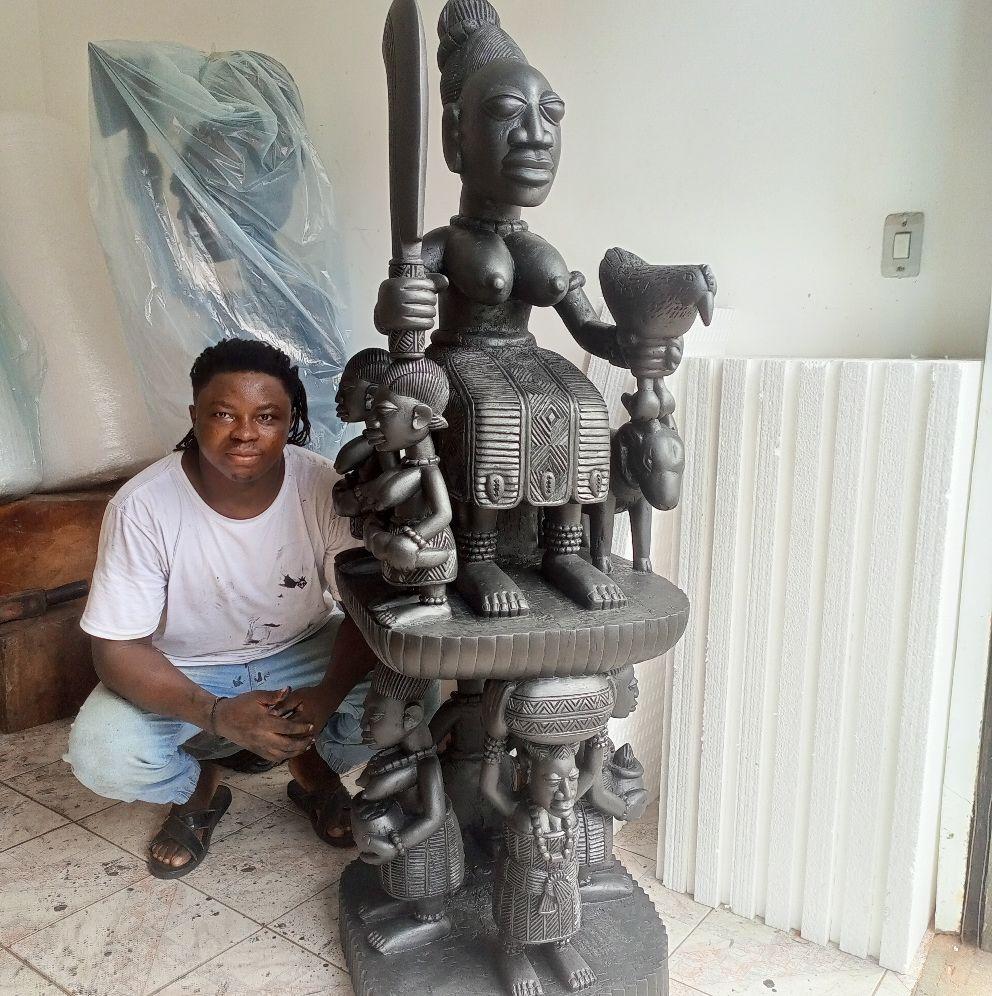
Among the Yoruba, long-standing spiritual practices gave rise to sculptural traditions that honored deities and ancestors through carved wood, bronze, and beadwork.
Objects were activated through ritual—they were not complete until they were used, touched, danced, or invoked. Art here was a living presence, inseparable from the rhythms of community life.
What connects these diverse geographies is a shared understanding of art as a bridge—between human and divine, visible and invisible, past and present.
Cross-Cultural / Conceptual Pairings
Venus of Willendorf
Early symbolic human representation tied to fertility and belief. Similar sculptures, first discovered in the nineteenth and early twentieth centuries, are traditionally referred to in archaeology as “Venus figurines”, due to the widely held belief that depictions of nude women with exaggerated sexual features represented an early fertility deity, perhaps a mother goddess. The reference to Venus is metaphorical, since the figurines predate the mythological figure of Venus by many thousands of years. Some scholars reject this terminology, instead referring to the statuette as the Woman of or from Willendorf
Newgrange
Passage tomb aligned with the winter solstice in Ireland